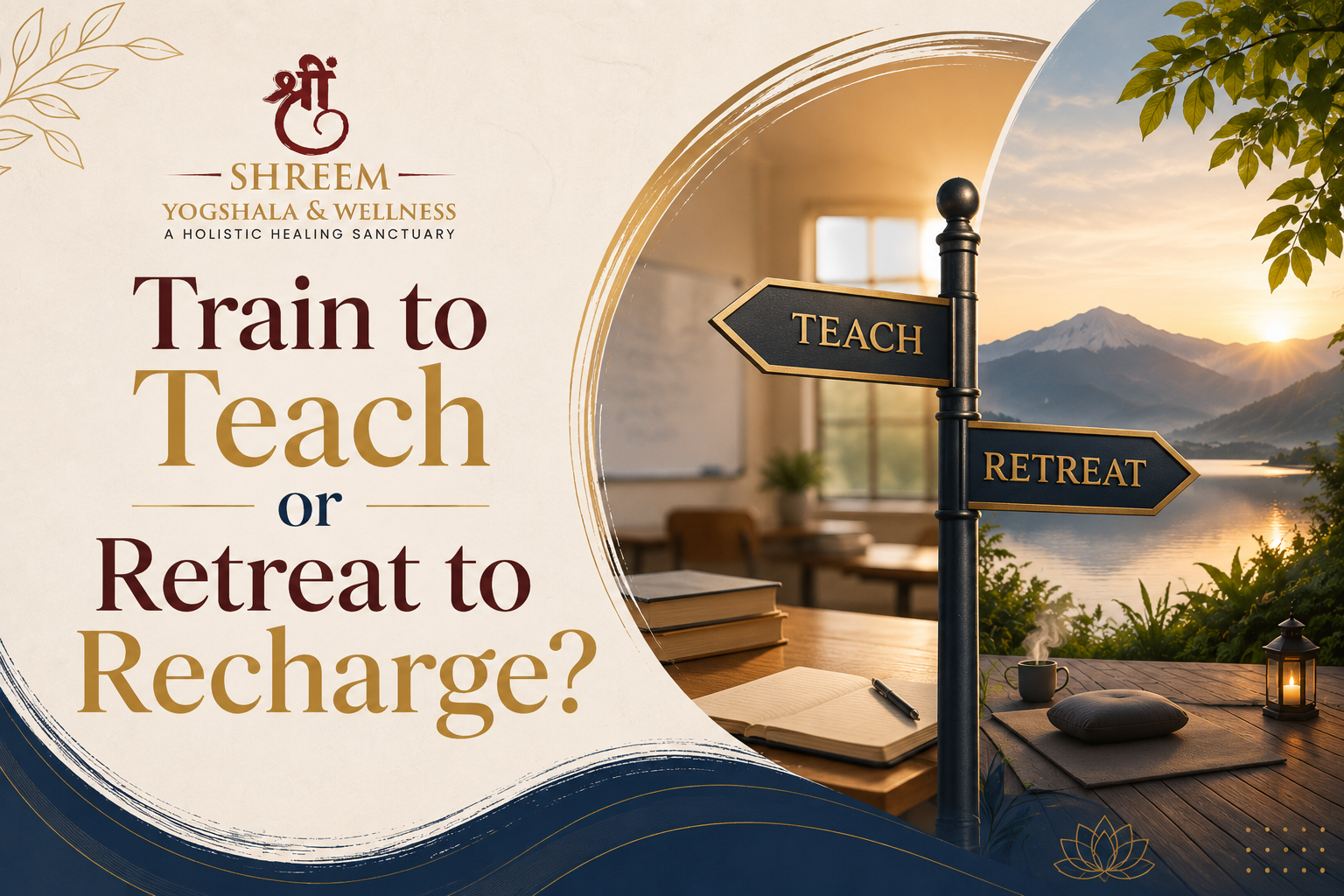
Yoga retreat vs yoga teacher training can look surprisingly similar online. Both may include morning practice, vegetarian meals, accommodation, meditation and time near the sea. Once you arrive, however, the experience can be very different.
A retreat gives you space to rest, practise and reconnect without having to prove what you have learned. A training asks you to study, participate, practise teaching and take responsibility for your progress.
Neither choice is automatically better. The right one depends on what you need from your time in Goa.
The Quick Answer
Choose a yoga retreat in Goa when you primarily want rest, guided practice and a temporary break from your normal routine.
Choose yoga training in Goa when you want a structured curriculum, detailed feedback, deeper theoretical knowledge or preparation to teach.
At Shreem Yogshala, retreat guests can choose shorter stays of 3, 5, 7, 10 or 15 days. Its 200-hour teacher training is a 25-day residential course covering Hatha, Vinyasa and Ashtanga alongside anatomy, philosophy, meditation and teaching methodology.
|
Consideration |
Yoga training |
Yoga retreat |
| Main purpose | Education and skill development | Rest, practice and personal wellbeing |
| Daily pace | Structured and academically demanding | Guided but generally lighter |
| Theory classes | Central part of the program | Usually limited or optional |
| Teaching practice | Normally required | Not required |
| Assessment | May include practical evaluation | Usually none |
| Free time | Limited on study days | More flexible |
| Certificate | May be awarded after completion | Not normally a teaching qualification |
| Best suited to | Serious students and aspiring teachers | Beginners, travellers and tired practitioners |
What Yoga Training in Goa Actually Involves
Teacher training is not simply an extended yoga holiday.
Your day may begin with meditation or pranayama, followed by asana practice. Later sessions can include anatomy, philosophy, alignment, sequencing, cueing, classroom management and teaching practice.
You may also have reading, note-taking, peer observation and practical assignments. During practicum, you are expected to explain postures, give understandable instructions, observe students and adjust your class when something is not working.
Shreem Yogshala’s 200-hour multi-style curriculum includes Hatha, Vinyasa and Ashtanga, as well as anatomy, yogic philosophy, meditation, teaching methodology and the business of yoga. The program also includes residential accommodation, three daily satvik meals, course materials and an Ayurvedic consultation.
Training may suit you when:
You want to understand why a sequence is constructed in a particular way, not only follow it.
You are prepared to receive feedback on your communication, alignment knowledge and teaching choices.
You can commit to early mornings, scheduled lessons and regular participation.
You want to build a serious personal practice, even when teaching is not your immediate goal.
You understand that receiving a certificate is the beginning of professional development, not proof that you have mastered every branch of yoga.
What a Yoga Retreat in Goa Actually Feels Like
A retreat replaces academic pressure with supported routine.
You still wake up for yoga, meditation or breathwork, but you are not normally expected to memorise anatomy, prepare a class or complete a teaching assessment.
At Shreem Yogshala, the yoga and meditation retreat includes Hatha, Vinyasa and Yin sessions, guided meditation, pranayama, Yoga Nidra, restorative practices, satvik meals and accommodation. Retreat durations can be adjusted from a short three-day stay to a longer 15-day experience.
A retreat may therefore be the better choice when your current problem is not lack of knowledge. It may be exhaustion, an inconsistent routine, too much screen time or the feeling that yoga has become another task to complete.
A retreat may suit you when:
You want guided practice without studying for a qualification.
You are new to yoga and would like to experience several styles before choosing a course.
You have limited annual leave.
You are recovering from a demanding period and do not want a heavily scheduled program.
You want to explore whether residential yogic living feels right before committing to several weeks of training.
A Retreat Is Not a Less Serious Choice
People sometimes view a retreat as the “easy” option and teacher training as the more meaningful path. That comparison is not helpful.
The seriousness of an experience depends on your intention.
A person who attends teacher training mainly for a photograph and certificate may learn less than someone who spends five retreat days developing an honest, sustainable practice.
A retreat can help you observe how your body responds to morning practice, quieter evenings, shared meals and reduced stimulation. Those observations may give you a better foundation for future training.
Can You Join Teacher Training Without Wanting to Teach?
Yes.
Many people complete a 200-hour course because they want a more disciplined personal practice or a fuller understanding of yoga.
A teaching curriculum can still be valuable because learning how to explain a posture exposes gaps in your own knowledge. Anatomy classes help you question universal alignment instructions. Philosophy introduces yoga beyond physical exercise. Practicum requires you to communicate clearly rather than rely only on intuition.
Shreem Yogshala states that its 200-hour program is also open to students seeking personal development rather than a teaching career. A minimum of around six months of regular practice is recommended, although advanced flexibility is not required.
Should You Take a Retreat Before Teacher Training?
A retreat first is sensible when you are uncertain about residential learning or have practised yoga only occasionally.
During a short retreat, pay attention to more than whether you enjoy the classes. Notice whether you are comfortable with early starts, shared routines, plant-based meals, quiet periods and living close to other participants.
You can also observe the school’s teaching culture. Do instructors welcome questions? Are modifications offered? Are boundaries respected? Does the schedule leave enough time for meals and recovery?
These details matter more during a 25-day course than they do during a weekend visit.
Questions to Ask Before Booking Either Program
Do not choose based only on beach photographs, room design or the promise of “transformation.”
Ask for the current daily timetable. Find out how much of the program is compulsory, how large the group will be and which teachers will lead the course.
For training, ask how much practicum is included, how students are assessed and what the certificate qualifies you to apply for.
For a retreat, ask whether classes are adaptable, whether treatments are optional and how the itinerary changes across different stay lengths.
You should also disclose injuries, medications, dietary restrictions or health conditions before arriving. A responsible school should be able to explain what it can accommodate without making unrealistic promises.
The Best Choice Depends on What You Need Now
Choose training when you are ready to study, practise consistently and be accountable for what you learn.
Choose a retreat when you need breathing room, guided practice and time to understand what your next step should be.
You do not have to turn every visit to Goa into a professional qualification. Sometimes a retreat is enough. At other times, the desire to understand and eventually teach becomes too strong to ignore.
The right program is the one that honestly matches your current capacity, not the one that sounds more impressive when you describe it to someone else.